
According to the world energy outlook (WEO) of 2014, 634 million people do not have access to electricity in Africa, with a 32% rate of electrification in urban area and 17% in rural area. In 2013, it was estimated that more than 13 billion dollars were invested to improve access to electricity and clean cooking facilities. That number increases every year and more than a hundred of projects are given green light. Nevertheless, those efforts seem to be fruitless in most sub-Saharan African countries. What are we doing wrong?
Re-define the way we ‘help’ poor communities
We all know the proverb: “Give a man a fish and you feed him for a day; teach a man to fish and you feed him for a lifetime”. Yet, we do not apply it in our everyday lives, especially when it comes to helping poor countries. An article has recently been published on how ‘voluntourism’ is a not the way to help. It happens when foreigners decide to do both tourism and volunteering during their trip to poor countries. They think it is a great way to help but they do more harm than good. A simple video tried to illustrate the consequences of giving mindlessly. It shows a foreigner coming to a village and giving candies to children. The kids then chose not to go to school. What’s for? They can just ask the foreigner for money.
The reason why NGOs like WWF attains their goals is that the organizations are located in the regions they want to help. In addition, their works last for decades and the people in charge are not foreigners but locals. Therefore, they feel involved in the projects. In Senegal, the company ‘Energy R’ understands the importance of the involvement of the community where they bring lights. In fact, they work in the electrification of rural area. Instead of doing the work by themselves, they involve everyone in the community and make them feel like the project is theirs. In the beginning of each projects, a meeting is held between the company and the community about the needs of the village but also, their capacity of payment. As Yvonne Faye explained in the video ‘Think again’, the people knows the benefit they receive thanks to the electrification of their village and will be the one losing those privileges if they do not take care of the power plant. Although the locals are the primary responsible for the power plant, the company procede to do a checkup from time to time.
Many projects fail to involve locals whether by not training the people to do maintenance or by performing their work for free and not doing a follow-up. As a result, the power plants are degrading over time. Without maintenances, they do not work properly and the community is back to square one. In some worst-case scenario, poverty will incite people to steal the infrastructure and sell them for other purposes.
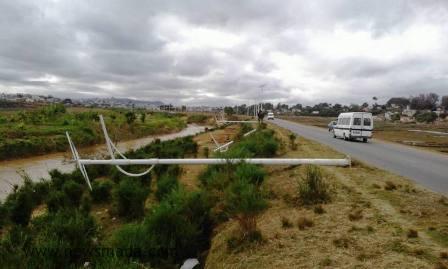
People stole the solar panels for the lampposts in Antananarivo Madagascar. 13/07/2016/ Photo from Facebook
Measurement is key
Urban areas have a higher rate of electrification. However, the population constantly experience rolling black out. Rolling black out can be caused by the insufficient generation capacity or inadequate transmission infrastructure to deliver power. In developed countries, utilities mitigate the problem of over-generation and peak loads using supply-side and demand-side management. In developing countries, I like to think that above all, we need supply-side and demand-side measurement. There is a saying: “If you can’t measure something, you can’t understand it. If you can’t understand it, you can’t control it. If you can’t control it, you can’t improve it”. That is exactly the problem in Sub-Saharan countries. They do not know how much energy they can produce or need to buy and they do not know how much energy they need.
‘Mojec international’, a company in Nigeria is aware of the importance of metering. In fact, they are manufacturing smart meters. In contrast to conventional meters, smart meters do not only display the quantity measured but save data as well. Moreover, these data can be retrieved and communicated to a control system for analysis. As explained in video ‘Think again’, metering is the collecting point of all the investment done so far. For the utilities, smart, reliable meters ensure that their dues are paid. In poor countries, it is not uncommon that the neighbors are tapping into your connection. These smart meters also prevent such occurrence and that consumers only pay for the energy they used.
Metering offers another opportunity for the supply side of the power sector. Often, the power plant in poor countries are obsolete and their maintenances are neglected. As a result, an increase of power losses are observed. However, before jumping into replacing the equipment , it is important to assess their performance. This is where smart meters enter into play. With metering, we could conduct an audit of the whole system and determine what equipment is the least efficient and where most of the energy is lost. Only after this, we can proceed to the improvement of the system. Moreover, it is imperative to understand that a monitoring system should be installed in order to maintain the efficiency of the whole plant. Again, smart meters to the rescue.
Another crucial use of metering systems can be found in the determination of the needs of the consumer. Nowadays, the integration of renewable energy sources (RES) are more and more popular. In order to install a power plant, we need to know how much power and energy the system needs to generate. The sizing of a power plant is even more important when the sources are renewables because of their intermittency. If the system has battery bank, the sizing of that system is also necessary in order to maximize the intake from the RES.
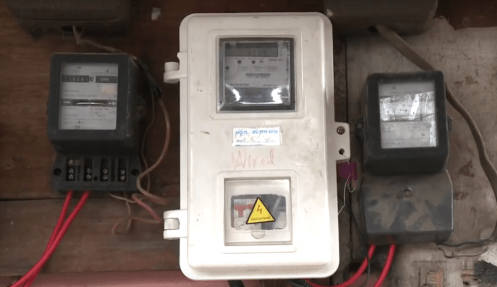
Old utility meters in Nigeria. Source: Think again – a documentary film on women in energy done by ECREEE (ECOWAS Center for Renewable Energy and Energy Efficiency)
Think big
In helping poor countries, we sometimes forget one thing: they might be poor now but they will not be in the future, at least, we hope so. Organizations provide poor communities lighting such as solar lamp, solar charger for their phone and one or two panels on the rooftop of schools, etc. Certainly, it helps but it is not durable. For instance, people in developed countries are not expected to find those sources of energy sufficient for their needs. Yes, rooftop solar systems generate energy, but we still withdraw power from the grid from time to time. Solar energy and off-grid systems should not be considered as the ultimate solution for Africa, not yet. They are an “éclaireur” or a pathfinder.
The role of the grid is questioned even in developed countries. People think that as everybody will produce their own energy, they will not need the grid anymore. This notion of distributed generation is exactly the reason why the grid is necessary. In fact, renewable energy sources are not evenly distributed. Some regions will have more share of solar power while in others, wind will blow more often but never constantly. Batteries will definitely help in peak generation/consumption shaving but it is not enough. This is the reason why Europe is trying to build a unified grid as it allows an exchange of power from where it is available to where it is needed, at a given time. A geographic balancing of volatile RES generation is crucial in delivering reliable energy whether in Africa or elsewhere.
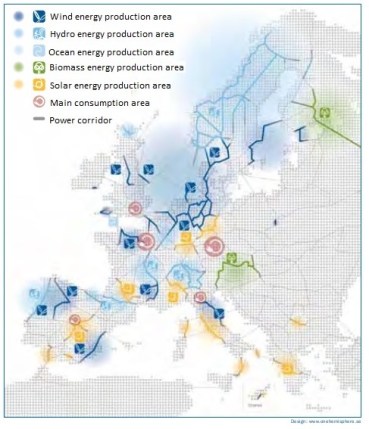
European renewable energy grid – the map for 2020. Source: European Wind Energy Association.
Next time we think of a project to increase the access to electricity in Africa, we need to make sure that it answers four factors:
- Affordability – How much can the community pay? Do not just help.
- Durability – How long will it last after the intervention? Give the projects a real value.
- Efficiency – Does the system work as well as in the beginning? Monitor the system.
- Scalability – Are we taking into account the future of the communities in a world where we try to eradicate poverty? Put them in your place.
In other words, the project must be sustainable.
 world-energies.com